Bio-Volumentations
Bio-Volumentations is an image augmentation and preprocessing package for 3D (volumetric), 4D (time-lapse volumetric or multi-channel volumetric), and 5D (time-lapse multi-channel volumetric) biomedical images and their annotations.
It is a handy tool for image manipulation in machine learning applications. The library can transform 3D to 5D images with image-based and point-based annotations, gives you fine-grained control over the transformation pipelines, and can be used with any major Python deep learning library (including PyTorch, PyTorch Lightning, TensorFlow, and Keras) in a wide range of applications including classification, object detection, semantic & instance segmentation, and object tracking.
How to use
You can install the Bio-Volumentations library from PyPI using: pip install bio-volumentations
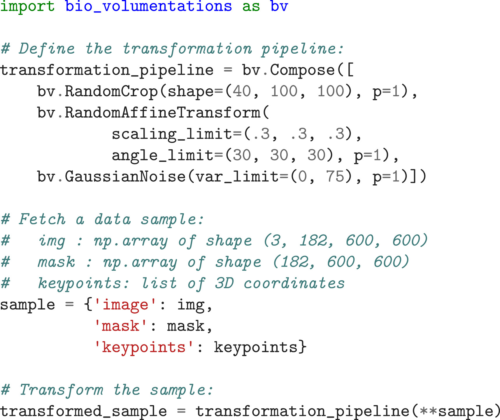
Bio-Volumentations work similarly to Albumentations or TorchIO:
- Define the transformation pipeline: specify a list of transformations and their parameters
- Transform your data sample: feed your data sample (images and their annotations) into the pipeline
The pipeline can process multiple images and additional targets in a single call, which is crucial for random augmentations when the entire sample needs to be transformed consistently. The pipeline accepts individual compounds of a sample as key-word arguments and outputs a dictionary with the same set of keys pointing to the transformed data. The keys of the input arguments of Compose can be customized when instantiating the transformation pipeline. Please visit our user guide or check out the example script at GitLab or API reference to learn more about using the library.
Features
- Random & deterministic transformations
- Point, local & geometric transformations
- Supports 3D to 5D images (volumetric time-lapse multichannel images)
- Supports mask annotations
- Supports keypoint annotations
- DL framework agnostic

Terms of use
The Bio-Volumentations library is distributed under the MIT License. For more details, see the licence file at GitLab.
If you find our library useful, please cite its journal publication as:
Lucia Hradecká, Filip Lux, Samuel Šuľan, Petr Matula. Bio-Volumentations: A Python library for augmentation of volumetric image sequences. SoftwareX, 2025, vol. 30, 102151. DOI: 10.1016/j.softx.2025.102151.
Thank you! :)
Acknowledgement
We acknowledge the support of the Ministry of Education, Youth and Sports of the Czech Republic (MEYS CR) (Czech-BioImaging Project LM2023050), the Czech Science Foundation [GA21-20374S], and the Brno City Municipality (Brno Ph.D. Talent Scholarship to L.H.). In addition, we thank Nathan Secretin for his technical assistance, Erik Sedlák for testing the library, and Matea Brezak and Vi Ngan Tran for providing image data to test the library.
Credits
- Lucia Hradecká (coordinator, software development)
- Filip Lux (coordinator, software development)
- Samuel Šuľan (software development)
- Petr Matula (supervision)